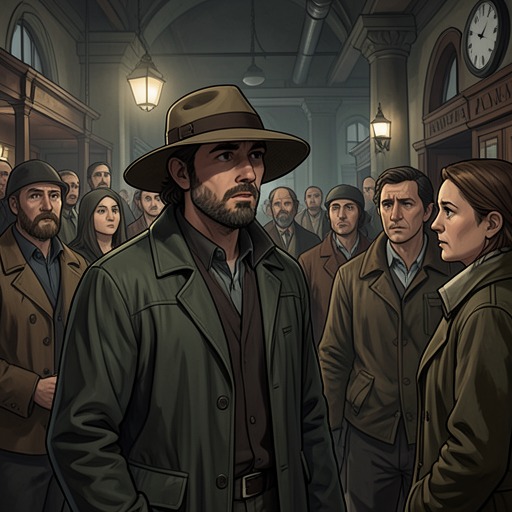
George (Charlie case)
Just MercyGeorge is Charlie’s mother’s boyfriend, a local police officer whose violence at home culminates in his death at Charlie’s hands. The account presents two sharply contrasting versions of him: to the community, a law enforcement officer remembered as honorable; within the household, a source of recurring fear and injury. That contrast shapes not only the night Charlie shoots him but also the decision to prosecute the boy as an adult.
Identity and Background
George lived with Charlie and Charlie’s mother for eighteen months. She later described their relationship as a mistake. During that period, he often came home drunk and acted violently. On three occasions, his beatings of her were severe enough that she needed medical treatment. Although she told several people she knew she should leave him or make him leave, she did neither. The account gives the household’s danger a history: the shooting follows repeated abuse, not a single isolated disagreement.
George had never struck Charlie, but the boy was afraid of him. Charlie found George unfriendly even when he was sober, and understood him as almost constantly angry. His mother told Charlie that George could be sweet, but Charlie had not experienced that side of him. George had also made at least one gesture Charlie remembered as kind: he offered the boy an Auburn University T-shirt that was too small for George and too large for Charlie. That gift would later matter for a different reason, because Charlie had discovered George’s hidden handgun while looking for the shirt.
The narrative also supplies a loss that Charlie had heard about: George’s first wife and child had died in a car accident. Charlie’s mother said this was why George drank so much. The detail offers a reported explanation for George’s drinking, but it does not erase the consequences of his conduct at home. For Charlie, the eighteen months of drinking, violence, arguments, threats, and turmoil had changed his mother; she seemed nervous and jumpy and no longer smiled as she once had.
The Household and Its History of Violence
On the night of the shooting, Charlie and his mother were playing cards when George came home very drunk. Earlier that evening, she had pleaded with him not to go out because she feared he would return intoxicated. Now, when she saw him in the kitchen, she looked at him angrily; he responded with contempt and struck her hard in the face. The blow knocked her down, and her head hit the metal kitchen counter. George then passed Charlie and went to the bedroom, leaving Charlie’s mother unconscious and bleeding on the floor.
Charlie tried to stop the bleeding. He put paper towels behind his mother’s head, then searched for a cloth towel, which he found wrapped around a pot on the stove. The family had eaten black-eyed peas before beginning a game of pinochle, Charlie’s favorite card game. The ordinary details of dinner and play sit beside the sudden emergency: the towel that had been part of the kitchen routine became an attempt to keep his mother alive.
Charlie thought he needed to call an ambulance, but the telephone was in the bedroom where George had gone. The boy knew George was asleep, yet fear still shaped his movements. As a younger child, Charlie sometimes trembled when badly frightened, and the shaking was often followed by a nosebleed. Sitting beside his injured mother, he began to tremble and his nose started bleeding. He wiped it away and focused on what he thought he had to do. After nearly fifteen minutes without movement from his mother, he heard George breathing heavily in the other room and then snoring.
The Shooting and Its Immediate Consequences
Charlie had been stroking his mother’s hair and hoping she would wake. When the towel became saturated and blood spread onto his pants, he feared she might be dying or already dead. He got up to reach the telephone. In the bedroom, George was asleep. Charlie felt hatred toward him, remembering the violence and the way his mother had become fearful and unsettled. The phone was in a dresser drawer’s reach, but Charlie opened the drawer and reached beneath folded white T-shirts for George’s handgun, which he had previously found while looking for the oversized Auburn shirt. He had never fired a gun before.
Charlie approached the bed with both arms extended and pointed the gun at George’s head. George’s snoring stopped; in the sudden quiet, Charlie pulled the trigger. The gun’s report and recoil surprised him, and he nearly lost his balance. He shut his eyes, began trembling again, and then heard his mother moan. Realizing she was alive, he returned to the telephone, called 911, and stayed beside her until the police arrived. George’s death and Charlie’s attempt to summon help thus occur within the same crisis: the boy first acts against the man he fears, then calls for emergency assistance for his injured mother.
Public Reputation and the Adult-Prosecution Decision
The prosecutor did not dispute the account Charlie and his mother gave of the events. But George’s position as a local police officer altered how his death was presented. The prosecutor described him as a good man who had served honorably and characterized the killing as a great loss to the county. He sought to have Charlie tried as an adult and announced an intention to pursue the maximum punishment permitted by law. The judge agreed that the case was capital murder and that Charlie should be tried as an adult; Charlie was taken immediately to the county jail for adults.
The decision stands in tension with the facts of Charlie’s age and background. He was fourteen, weighed under one hundred pounds, and stood five feet tall. He had no juvenile criminal history, no prior arrests or school misconduct, and no earlier court appearances. He was a good student with several perfect-attendance certificates. Those details do not make George’s death less consequential, but they show how quickly the case’s public frame moved from a child facing a frightening household emergency to the killing of a respected officer for which the maximum punishment was sought.
Narrative Role and Significance
George is not developed through an extended account of his own perspective; the reader encounters him through Charlie’s memories, his mother’s account, and the community’s response to his death. The narrative preserves the difference between an explanation for his drinking and an excuse for his violence. It also places his official standing beside the private history of abuse, showing how one identity could command public sympathy while the suffering inside his household had been repeated and known.
His death becomes the point at which the justice system’s treatment of Charlie is set in motion. The same facts that make the shooting intelligible—the assault on Charlie’s mother, the inaccessible telephone, the sleeping George, and Charlie’s fear—do not prevent an adult prosecution. George’s role in the story is therefore not simply that of the man Charlie kills. His public reputation and private conduct expose the disparity between how the community mourns him and how little protection the household had received before the fatal night.